There’s no single official number. Three guidelines disagree on the exact interval: a 2015 expert consensus statement recommends 2-4 hours of standing a day, Cornell suggests a 20-8-2 cycle (20 min sit, 8 stand, 2 move), and Mayo Clinic says move every 30 minutes. All three agree frequent breaks and movement matter most.
By standingdeskconverters.com Editorial Team · Last updated: November 13, 2026
Key takeaways
- No single authority sets one “correct” number of standing hours. Three credible sources give three different intervals.
- A 2015 UK expert consensus statement (published in the British Journal of Sports Medicine) recommends building up to 2-4 hours of standing and light activity across a workday, gradually.
- Cornell’s ergonomics center recommends a 20-8-2 pattern — and explicitly states the exact timing isn’t critical, movement is what matters.
- Mayo Clinic’s guidance (from Dr. Edward Laskowski) is simpler: get up and move for 2-3 minutes roughly every 30 minutes, regardless of a specific hours-per-day target.
- A manual (gas-spring or crank) converter takes more effort to raise than an electric one, so realistic schedules differ by converter type — this adjustment is this site’s own practical reasoning, not a cited study.

Why don’t the experts agree on one number?
If you haven’t finished setting up the converter itself — getting the height and monitor position right first — start with our full setup guide, since no standing schedule helps much if the setup itself is uncomfortable. Beyond setup, the three guidelines below disagree because they’re measuring and framing the question differently. The 2015 expert consensus statement, written by a panel of UK academics in exercise physiology, ergonomics, and epidemiology, focused on a total daily accumulation target for standing and light activity. Cornell’s ergonomics center focused on a repeatable cycle to break up prolonged sitting during focused desk work. Mayo Clinic’s guidance is framed around a simple, memorable reminder rather than a research-derived ratio. None of them contradicts the others on the core point — sitting for hours without a break is the thing to avoid — they just express the fix differently.
What does each guideline actually say?
The BJSM 2015 expert consensus: 2-4 hours a day
In June 2015, a panel of UK researchers published an expert consensus statement in the British Journal of Sports Medicine recommending that desk-based workers aim to initially accumulate a total of 2 hours per day of standing and light activity at work, progressing gradually to 4 hours per day. The statement specifically cautions that prolonged, static standing postures should also be avoided — the goal is standing and light movement, not just trading sitting for motionless standing.
Cornell’s 20-8-2 pattern
Cornell’s CUErgo ergonomics center recommends a cycle: every 20 minutes, sit, then stand for 8 minutes and move for 2 minutes. Cornell is explicit that “the absolute time isn’t critical,” suggesting roughly every 20-30 minutes as a reasonable posture-break interval, and that movement — not simply standing still — is what helps circulation. Cornell’s own research is also notably skeptical of relying on sit-stand hardware alone: field studies it cites found users of dedicated sit-stand workstations stood for only about 15 minutes total per day on average, with compliance dropping further after the first month.
Mayo Clinic’s 30-minute reminder
Mayo Clinic Sports Medicine guidance, attributed to Dr. Edward Laskowski, recommends getting up and moving every half hour, even just for two to three minutes. This guidance also notes that standing alone, without movement, isn’t clearly established to lower the health risks associated with prolonged sitting — the movement component is doing the work, not the posture change by itself.
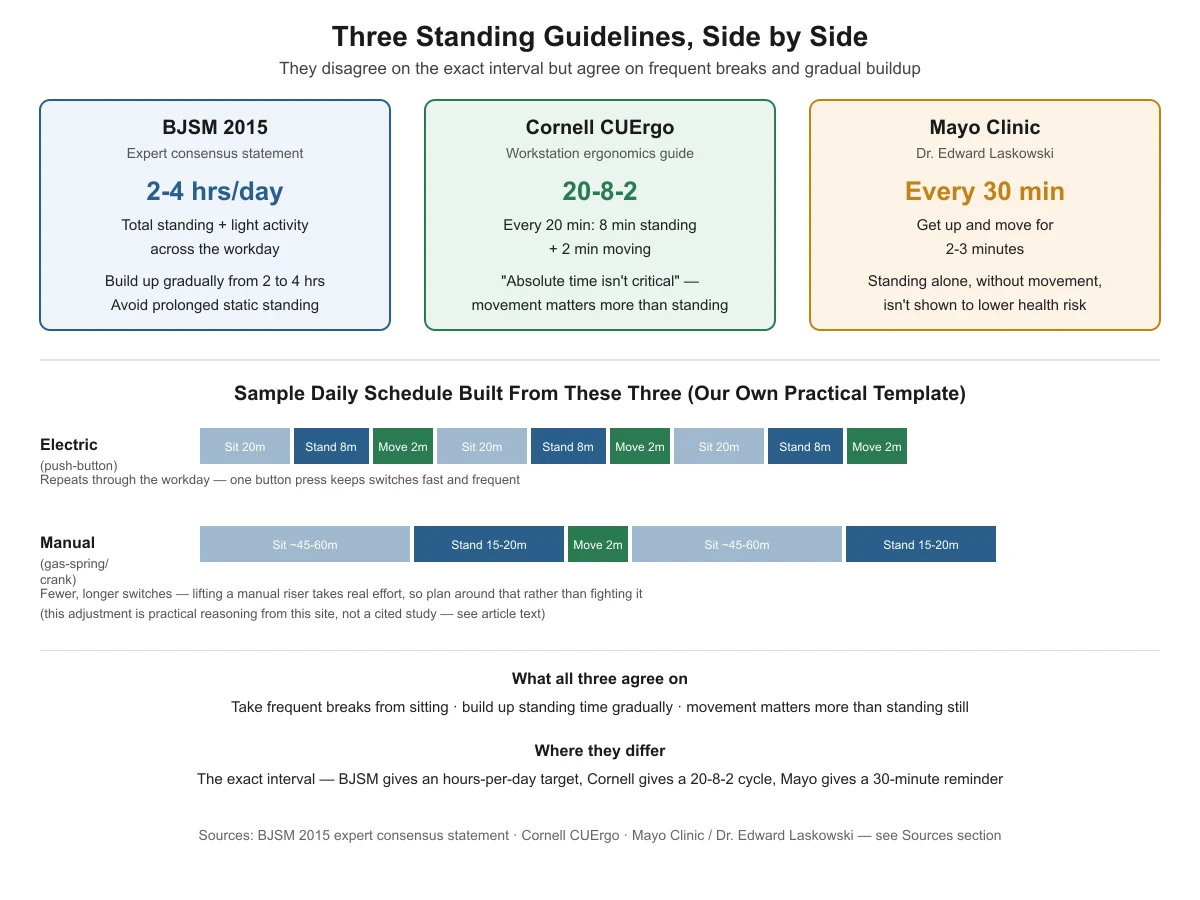
Three guidelines, side by side
| Source | What it recommends | Framing |
|---|---|---|
| BJSM 2015 expert consensus | 2-4 hours/day of standing + light activity, built up gradually | Total daily accumulation target |
| Cornell CUErgo | 20 min sit / 8 min stand / 2 min move cycle | Repeatable work-break cycle; exact timing “not critical” |
| Mayo Clinic (Dr. Edward Laskowski) | Get up and move every ~30 min for 2-3 minutes | Simple, memorable reminder |
What do they agree on, and what do they not agree on?
All three agree on three things: take frequent breaks from uninterrupted sitting, build up standing time gradually rather than jumping straight to hours of standing, and movement matters more than standing still. Where they genuinely differ is the exact interval — an hours-per-day total, a 20-8-2 cycle, or a 30-minute reminder aren’t the same schedule, and no single one of them is “more correct” than the others. Most general standing-desk content collapses these into one unified rule (commonly “2-4 hours a day, 15-30 minutes an hour”); that blended version isn’t wrong exactly, but it isn’t a direct quote from any one source either.
How should this differ for a manual versus an electric converter?
None of the three guidelines above distinguishes between manual and electric sit-stand hardware — that distinction doesn’t come from any cited research. It’s a practical observation, not a research finding: raising a manual (gas-spring or crank) converter takes active physical effort and roughly 10-30 seconds, compared to pressing a button on an electric converter for about 5-10 seconds. In practice, that friction difference means a realistic schedule for manual-converter users usually means fewer, longer switches rather than matching a short cycle like 20-8-2 exactly.
A practical template built from the three guidelines above, adjusted for that real-world friction:
- Electric converter: closer to Cornell’s 20-8-2 cycle is realistic, since switching costs almost nothing. Sit 20 minutes, stand 8, move 2, repeat through the day, working toward the 2-4 hour BJSM range as a running total.
- Manual converter: fewer switches, longer stretches — for example, sit roughly 45-60 minutes, then stand 15-20 minutes with 2 minutes of movement, repeating through the day. This still works toward a multi-hour daily total without fighting the converter’s own friction.
Either way, use a visible timer or calendar reminder at first. Cornell’s own data on sit-stand hardware compliance (standing dropping to about 15 minutes a day after a month without a plan) is a good reason not to rely on remembering.

How does this connect to switching frequency generally?
This article covers how many total hours and how long each stretch should run. For the broader question of how often to switch between sitting and standing in the first place, and more detail on the manual-vs-electric effort difference, see our sit-stand ratio guide. And if your converter doesn’t reach a comfortable standing height in the first place, no schedule will fix that — check our guide to a converter that feels too low before troubleshooting your schedule.

Frequently asked questions
Is 4 hours of standing a day too much?
The BJSM 2015 expert consensus treats 4 hours as the top end of a gradually-built-up target, not a hard ceiling to avoid. The same statement cautions against prolonged, static standing, so the 4 hours is meant to include movement and position changes, not 4 continuous motionless hours.
Which guideline should I actually follow?
There isn’t one “correct” answer among the three. A practical approach is to pick whichever cycle fits how your converter works — Cornell’s 20-8-2 if you have an electric converter and can switch easily, or longer, less frequent switches if you have a manual one — while keeping all three sources’ shared principle in mind: frequent breaks and movement matter more than hitting an exact number.
Do I need to hit these targets on day one?
No. All three sources that address pacing (BJSM explicitly, Cornell implicitly through its compliance data) point toward building up gradually rather than starting with hours of standing immediately. Start with short, frequent stands and increase over days or weeks.
Does standing without moving count toward these targets?
Not fully, according to Cornell and Mayo Clinic guidance. Both specifically note that movement, not static standing, is what provides the circulation benefit. Shifting weight, taking a few steps, or stretching during your standing time matters more than holding one still position.
What if I can’t keep up with switching every 20-30 minutes?
That’s normal, especially with a manual converter. Cornell’s own compliance data shows most dedicated sit-stand hardware users stand far less than guidelines suggest after the first month. A longer, less frequent schedule you’ll actually keep doing is more useful than an ambitious one you abandon.