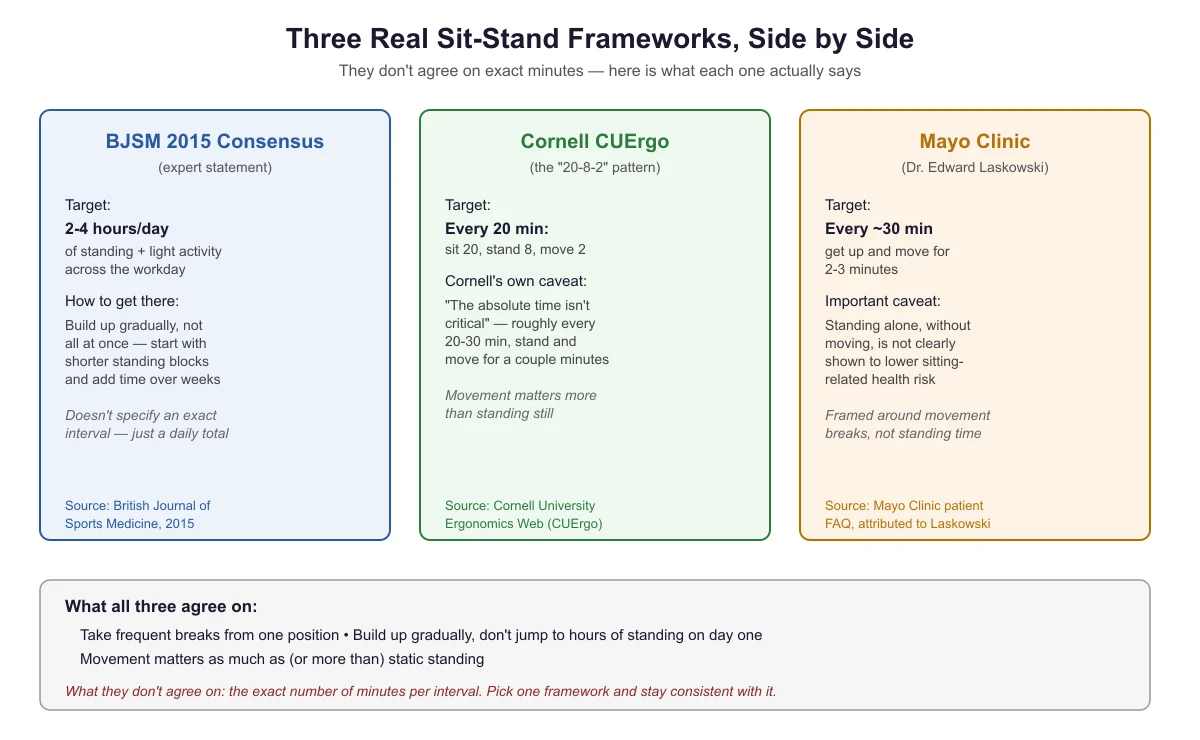
Direct answer: There is no single official sit-stand ratio. Cornell’s ergonomics guidelines describe roughly 20 minutes sitting, 8 minutes standing, and 2 minutes moving; the BJSM 2015 consensus statement targets 2-4 hours of standing across the whole day; Mayo Clinic suggests simply moving every 30 minutes. All three agree on the same underlying advice: build up gradually and move often.
Key takeaways
- Three credible sources give three different numbers. None of them is “the” official sit-stand ratio — treat all of them as starting points, not rules.
- Cornell’s own “20-8-2” page says directly that “the absolute time isn’t critical.”
- The BJSM 2015 consensus statement sets a daily total (2-4 hours of standing and light activity), not a specific interval you repeat.
- A manual, gas-spring or crank converter takes active effort to raise, which in practice discourages switching as often as a one-button electric desk — this is practical reasoning, not a finding from any study.
- Every source agrees that movement, not standing still, is what matters most for circulation and comfort.
Why Isn’t There One Official Sit-Stand Ratio?
Search results for this question often present “2-4 hours a day, switch every 30 minutes” as a single settled fact. It isn’t. Three separate, credible sources address this question, and they use different frameworks with different numbers. Here is what each one actually says, side by side. This builds on the elbow-height and eye-level setup covered in how to set up a standing desk converter correctly — getting the switching cadence right only helps once the converter itself is positioned correctly.
| Source | What it recommends | Key caveat in its own words |
|---|---|---|
| BJSM 2015 consensus statement | Build up to 2-4 hours/day of standing and light activity across the workday | A daily total, not a repeating interval; “initially progress towards” 2 hours before reaching 4 |
| Cornell CUErgo (“20-8-2”) | Roughly every 20 minutes: sit 20, stand 8, move 2 | “The absolute time isn’t critical” — about every 20-30 minutes, stand and move for a couple of minutes |
| Mayo Clinic (Dr. Edward Laskowski) | Get up and move roughly every 30 minutes for 2-3 minutes | Standing alone, without moving, is not clearly shown to lower sitting-related health risk |

What Does Cornell’s “20-8-2” Pattern Actually Say?
Cornell University’s ergonomics guidelines describe a pattern of sitting for about 20 minutes, standing for about 8, and moving for about 2. The same page is explicit that the exact minutes are not the point — it says the absolute time isn’t critical, and that roughly every 20-30 minutes you should take a posture break and stand and move for a couple of minutes.
That same Cornell page is also skeptical of dedicated sit-stand hardware in practice. It notes that field studies found users standing for as little as 15 minutes a day in total, and that compliance with new standing habits drops sharply — after about a month, a majority of people are back to sitting all the time. The lesson isn’t “don’t bother.” It’s that a schedule only works if you actually follow it, which is why the template later in this article is deliberately simple.
What Does the BJSM 2015 Consensus Statement Recommend?
The 2015 consensus statement published in the British Journal of Sports Medicine, written by an international group of experts, recommends that desk-based workers build toward accumulating 2 to 4 hours per day of standing and light activity during working hours, prorated for part-time schedules. It explicitly frames this as a gradual build-up — starting with shorter standing blocks and adding more over time — achieved through regular standing breaks, sit-stand equipment, or both. It does not specify a minute-by-minute interval; it sets a daily total.
What Does Mayo Clinic Say About How Often to Move?
Mayo Clinic’s sitting-risks guidance, attributed to Dr. Edward Laskowski, frames the advice around getting up and moving roughly every 30 minutes for 2 to 3 minutes. The more important point in that guidance is the caveat: standing by itself, without actually moving, is not clearly established to lower the health risks linked to prolonged sitting. That lines up with Cornell’s emphasis on movement over static posture, even though the exact interval Mayo suggests (30 minutes) differs from Cornell’s (20-30 minutes) and BJSM’s daily-total framing.

How Should Manual vs. Electric Converters Change Your Schedule?
None of the three sources above distinguishes between manual and electric sit-stand equipment. That gap matters for converter owners specifically, so the reasoning below is this article’s own practical observation, not a research finding — treat it as “in practice,” not “research shows.”
- Manual (gas-spring or crank) converters: raising or lowering the platform takes physical effort and roughly 10-30 seconds. In practice, that friction makes people switch less often than any of the frameworks above assume.
- Electric (button) converters: a single button press takes about 5-10 seconds with no physical effort, which makes frequent switching far more realistic to sustain.
If you own a manual converter and find yourself switching only two or three times a day instead of the 20-30 minute cadence Cornell describes, that is a known limitation of the hardware, not a failure on your part. If switching rarely happens because the converter’s maximum height never feels like a real standing position, the cause may be insufficient lift rather than low motivation — see why a standing desk converter feels too low, and how to fix it.
Leaning on the platform edge while deciding whether to switch is also worth watching for, since it is a habit specific to clamp-mount converters — see common standing desk converter posture mistakes for the self-check.
A Realistic Schedule Template for Converter Users
Given the three frameworks above and the manual-vs-electric friction difference, here is a practical starting schedule. It is this article’s own synthesis, explicitly built from the agreement points across all three sources: break up static time, build up gradually, and prioritize movement.
| Converter type | Suggested pattern | Why |
|---|---|---|
| Electric | Sit ~20 min, stand ~8 min, move/stretch ~2 min (Cornell’s pattern) | Low-effort switching makes the shorter cycle realistic to sustain |
| Manual | Switch every 45-60 minutes, aim for 2-4 total standing hours across the day (BJSM’s daily target) | Matches switching frequency to the physical effort required, while still working toward BJSM’s daily total |
Whichever pattern you use, treat “move for a minute or two” as equally important as “stand” — every source above agrees that movement is doing more work than static standing. For how many total hours a day you should aim to stand, including how that figure also differs by source, see how many hours a day you should stand with a desk converter.
Frequently Asked Questions
Is the “2-4 hours a day” rule the same as standing for 2-4 hours straight?
No. The BJSM 2015 consensus statement describes 2-4 hours of standing and light activity accumulated across the entire workday, built up gradually, not one continuous block. Breaking it into shorter standing periods throughout the day is the approach the statement actually describes.
Why does my converter make it harder to follow a 20-minute schedule?
If it’s a manual gas-spring or crank model, raising and lowering it takes active effort and extra time compared to pressing a button on an electric desk. No published source measures this directly, but in practice that friction is the most likely reason a tight 20-minute cycle feels unrealistic.
Does standing without moving still help?
According to Mayo Clinic’s guidance, it’s not clearly established that standing alone, without moving, lowers the health risks linked to prolonged sitting. Cornell’s guidance makes the same point from a different angle: movement is what the evidence actually supports, not static standing.
Should I just copy one of the three schedules exactly?
You can, but none of the three sources claims the others are wrong — they simply measure different things (a repeating interval vs. a daily total vs. a movement cadence). Picking one and staying consistent with it matters more than which one you pick.
Sources
- Cornell University Ergonomics Web (CUErgo) — Sitting and Standing (the “20-8-2” pattern, compliance caveats)
- PubMed — Buckley et al., “The sedentary office,” British Journal of Sports Medicine, 2015 (2-4 hours/day standing target)
- Mayo Clinic — Sitting risks: How harmful is too much sitting? (attributed to Dr. Edward Laskowski; every-30-minutes movement guidance)
standingdeskconverters.com Editorial Team. Last updated: November 13, 2026.